Glossary of terms
Conglomerate- multi industry companies, combination of different business (eg: Disney/Fox-sky tv)
Independent company- A company that works on its own and isn't influenced by anyone else
Public service model- business supplying a commodity(eg: gas) or service(eg:public transport)
Joint venture- media company works with another company on a project that is mutually beneficial for both parties.
Distribution- how a product or a brand reaches an audience (eg:web, cinema, television) and its marketing and promotion.
Mise-en-Scene (placing in the scene)- in films it refers to everything shown on the screen
Setting- where the film is set- studio, setting, location, production design.
Diegesis- the fictional world(time and place) of the narrative
Verisimilitude- how real this world appears
Diegetic effect- diegesis+verisimilitude
Props- anything held or used by an actor for use. Objects that are not used by the actors are set dressing.
Hero prop- any prop that has to be seen functioning eg- gun shot
Staging- process of selecting, designing, adapting to, or modifying the performance space for a film.
Blocking- position of actors on stage, their gestures and movements, the scenic background, props and costumes, and lighting. Can connote intimacy, closeness, camaraderie etc between characters.
Proxemics- spatial relationship between the characters
Costume- clothing that the character wears. Can be stereotypical or iconographic
Makeup- all actors are required to wear makeup to prevent their skin from poking shiny.
Prosthetic- special effect makeup that are used to change actors appearance
Figure expression- acting style, us elf facial expression to convey emotions
Figure movement- how things move on screen. Important for creating spectacle in action movies and musicals.
Cinematography- refers to all the lighting and camerawork in a film. (Shot types, camera angles, composition and aspect ratio, colour, lens type, camera movement)
1. Shot types-
- Closed shots- extreme close up, medium close up, close up, big close up
- Medium shots (showing locations, establishing spatial relationships)- medium close ups, media long shots, medium shots.
- Wide shots(show action, creating spectacle, establishing the location)- long shots, establishing shots, extreme long shot,master shots.
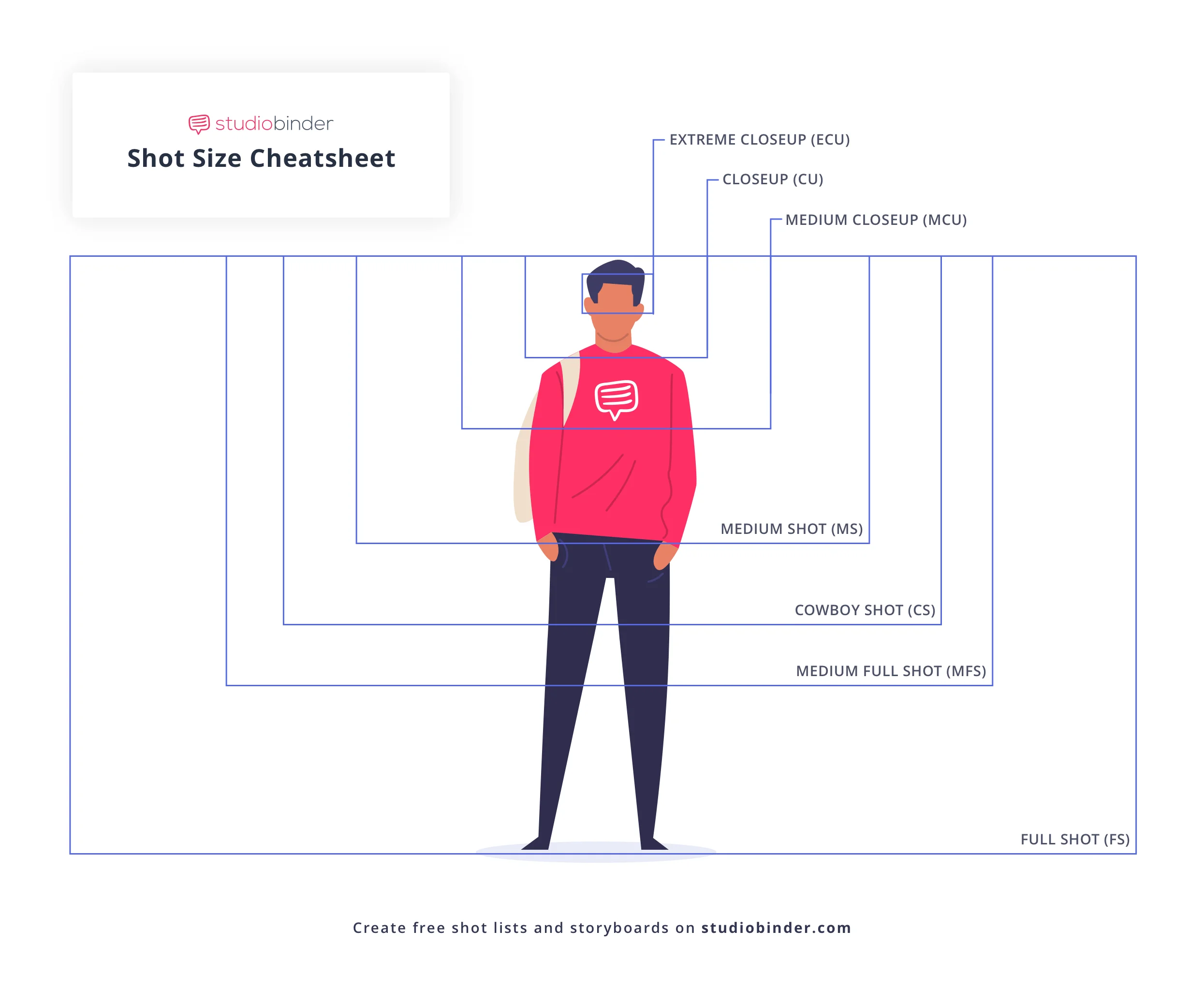
 |
- EWS- make your subject appear small against their location
- WS-bit closer, whole body in the shot but still showing location
- FS- camera movement is featured throughout the shot, tracking the subject or featuring multiple characters in one shot
- MPS-frames the subject knees up
- CS- frames the subject mid-thighs up, (used in western to film a gun on the hip)
- MS- frames roughly waist up and through the torso
- MCU-frames the subject roughly chest up, typically favors the face
- CU- reveals the subject's emotions and reactions, fills frame with part of your subject (usually their face)
- ECU- extreme close up, the most you can fill frame with your subject (often shows eyes mouth and gun triggers.)
Camera Angles
|
High angle- establishing locations, making subject look small, diminished, weak and powerless. looking down on things
Level- eye level, create empathy with the character, neutral shot Low angle- making subjects look big, tall, powerful. heroic or intimidating, looking up at things.  Dutch /canted angle- making things looking strange, surreal, scary, confusing, 'off-kilter' suggesting insanity or intoxication  Top shot- looking straight down at a subject  Aerial shot- shot taken from an aircraft, usually a helicopter but increasingly from a drone.  Aerial establishing- an establishing shot taken from an aircraft, looking straight down before tilting up to reveal the location.  P.O.V- showing what character us looking at and creating empathy with the character. Used for eyeline match or with insert shots.
Camera mounts-
Handheld shots- used for action sequences, to connote freedom, movement and excitement. To get in amongst the action. To imitate news footage or home movie footage. Axis movement- usually achieved by using a tripod to ensure a sturdy image. Arc Shots- used to connote show a 360 arc or confusion. Often used in aerial establishing shots. Crane shots- used for high angle and establishing shots and sweeping movement. Steadicam shots- used for action sequences, to connote freedom, movement and excitement to get into amongst the action, similar to handheld shots but smoother. Snorri Cam shots- used to connote intoxication, madness, sickness, very surreal.
Lens type and focus-
Normal lenses- focus length of about 35-50mm and the image it produces closely resembles the way in which the human eye perceives things. Wide angle lens- focal length, shorter than 35mm and have a wider viewing angle than the human eye, used for shotting confined spaces. Increase depth perception. Used to isolate characters from their environment. The wider the Lense the more distorted the image is. Telephoto Lens- used to make distant objects seem close but can foreshorten distance, making distant objects appear closer to the camera, flattening the image. Used to create shallow depth of field. Zoom lens- variable focal length, ranging from wide angle to telephoto. More versatile than fixed focal length lenses but can still distort the image slightly.
|


